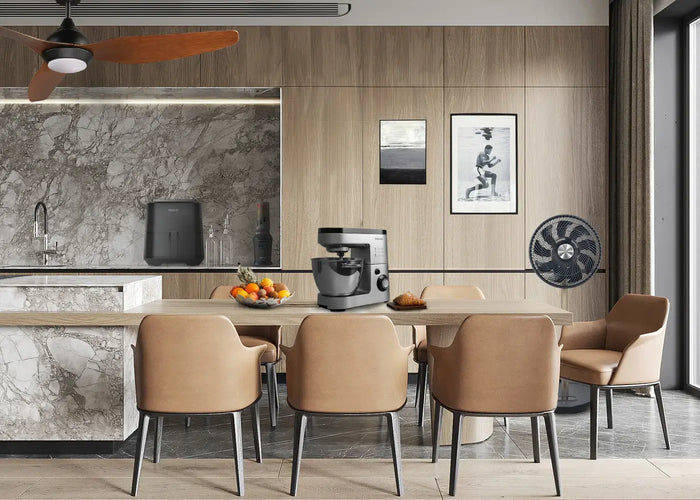
A good fan helps you feel comfortable without relying on air conditioning from morning to night. It keeps air moving through your home, uses relatively little electricity and makes hot afternoons and warm nights easier to manage.
Choosing the best ceiling fan in Malaysia comes down to room size, motor type and how you use the space. A stand fan offers another practical option when you need focused airflow or cannot install a permanent fixture.
Why It Feels Hotter During the Mid-Year Dry Season
Malaysia’s Southwest Monsoon usually brings lower humidity, fewer rain clouds and more days without rain. For 2026, MET Malaysia expects this season to continue from May until September. Local and transboundary haze may also occur during its peak if open burning is not controlled.
A fan does not lower the actual room temperature, but moving air helps sweat evaporate and makes your skin feel cooler. This makes ceiling fans a sensible first step before you switch on the air conditioner.
Ceiling Fan vs Stand Fan: Which Should You Buy?
Both provide effective airflow, but they solve different problems.
|
Factor |
Ceiling fan |
Stand fan |
|
Coverage |
Spreads air across a room |
Directs air towards a specific area |
|
Floor space |
Uses no floor space |
Needs a stable floor position |
|
Installation |
Requires secure installation |
Ready to use with a suitable socket |
|
Flexibility |
Stays in one room |
Moves between rooms |
|
Best for |
Bedrooms, dining areas and living rooms |
Renters, home offices and targeted cooling |
A ceiling fan makes sense for a room that you use every day. Choose a stand fan Malaysia households can move it easily if you rent, need flexible cooling or want extra airflow beside a sofa or bed.
DC vs AC Motor Fans: The Electricity-Bill Difference
AC fans use a conventional alternating-current motor. They generally cost less upfront and provide dependable cooling with simple speed controls.
DC fans convert electricity to direct current within the appliance. They often use less power, run more quietly and offer more speed settings. A modern ceiling fan with a DC motor may also include reverse rotation, timers and a remote.
What Is a DC Ceiling Fan?
A DC ceiling fan uses an electronically controlled direct-current motor. This motor can provide precise speed adjustment while consuming less electricity than many comparable AC models.
For example, the Mistral MCF561R uses 39W at its rated wattage and offers six speeds. Motor type alone does not determine performance, so compare power consumption, blade span and air delivery together.
How Much Can You Save on Your TNB Bill?
Calculate consumption with this formula:
Wattage ÷ 1,000 × hours used × days used = kWh
A 39W fan used for eight hours daily consumes about 9.36kWh over 30 days. Multiply that figure by the applicable rate on your TNB bill to estimate the cost.
Your savings depend on the model you replace and your usage. Running a fan with your air conditioner may also let you choose a less aggressive temperature setting, but comfort and savings will vary between homes.
How to Choose the Right Fan for Each Room
Start with the room rather than the design. A large fan in a cramped bedroom may feel overpowering, while a small fan will struggle to circulate air through an open living area.
Check the published airflow or CFM where available. Higher airflow helps in larger rooms, but bedrooms also benefit from quiet operation and lower speed settings.
Blade Span by Room Size
Use this as a general starting point and confirm the manufacturer’s installation requirements:
|
Room size |
Suggested blade span |
|
Below 7m² |
29 to 36 inches |
|
7 to 13m² |
36 to 48 inches |
|
13 to 21m² |
48 to 54 inches |
|
Above 21m² |
54 to 60 inches |
Ceiling height, layout and furniture can affect the result. Keep blades a safe distance from walls, lights and cabinets.
Features Worth Paying For
A remote helps when you install the fan above a bed or large seating area. Timers prevent unnecessary overnight use, while several speed steps give you finer control.
Smart or app control adds convenience if you already manage household devices from your phone. Do not pay extra for it if a remote and timer meet your needs.
Best Mistral Ceiling Fans for Malaysian Homes
These Mistral models available through Mayer Malaysia suit different spaces and priorities:
- Mistral MCF60LE 60-inch Ceiling Fan: Its wide blade span suits larger living or dining areas. It also comes in black or white for easier coordination with your interior.
- Mistral MCF60AM 60-inch Ceiling Fan: Another large-room option for broad air distribution and everyday family spaces.
- Mistral MCF16R Decorative Corner Ceiling Fan: Its compact corner-mounted design suits smaller areas where a standard ceiling fan may not fit. The walnut and matte-black finishes also give it the character of a modern ceiling fan.
Review the current Mistral ceiling fan collection for specifications, prices and availability.
Best Mistral Stand Fans for Flexible Cooling
The Mistral MSF1697DR 16-inch BLDC Stand Fan combines nine speeds, three modes, a nine-hour timer and remote control. Its power consumption ranges from 3.7W on low to 29.5W on high.
For simple everyday cooling, the Mistral MSF165FB uses an AC motor and five blades. The Mistral MHV1412R-G suits spaces where you want stronger, more concentrated airflow from a high-velocity stand fan.
You can compare these options in the Mistral fan collection.
Simple Ways to Feel Cooler and Use Less Aircon
- Run your fan with the air conditioner to distribute cooled air.
- Open windows on opposite sides when outdoor air feels cooler, and air quality is suitable.
- Close curtains during the hottest part of the day.
- Use lower fan speeds at night for quieter airflow.
- Turn fans off when nobody occupies the room.
Keep Comfort Within Easy Reach
The right fan makes your home feel lighter, calmer and more comfortable through Malaysia’s warmest days. It gives your family dependable airflow while helping you manage how often you reach for the air conditioner.
Explore Mayer Malaysia’s ceiling fans and portable fan range to find the right fit.
Frequently Asked Questions
Which cools better, a ceiling fan or a stand fan?
A ceiling fan covers more of the room. A stand fan provides stronger, targeted airflow.
Is a DC ceiling fan worth the extra cost?
It can be worthwhile if you use it daily and value lower power use, quieter operation and more speed settings.
How many blades are best?
Blade design, motor performance and airflow matter more than blade count alone.
What size ceiling fan do I need?
Match the blade span to your room dimensions and follow the manufacturer’s clearance requirements.
Can a fan lower my electricity bill compared with air conditioning?
A fan generally uses much less power. Actual savings depend on equipment wattage, operating time and your TNB tariff.
Are remote or smart controls worth it?
A remote and timer add practical convenience. Smart control only makes sense if you will use the connected features.